Interior Design Renderings: When to Trust What You Cannot See
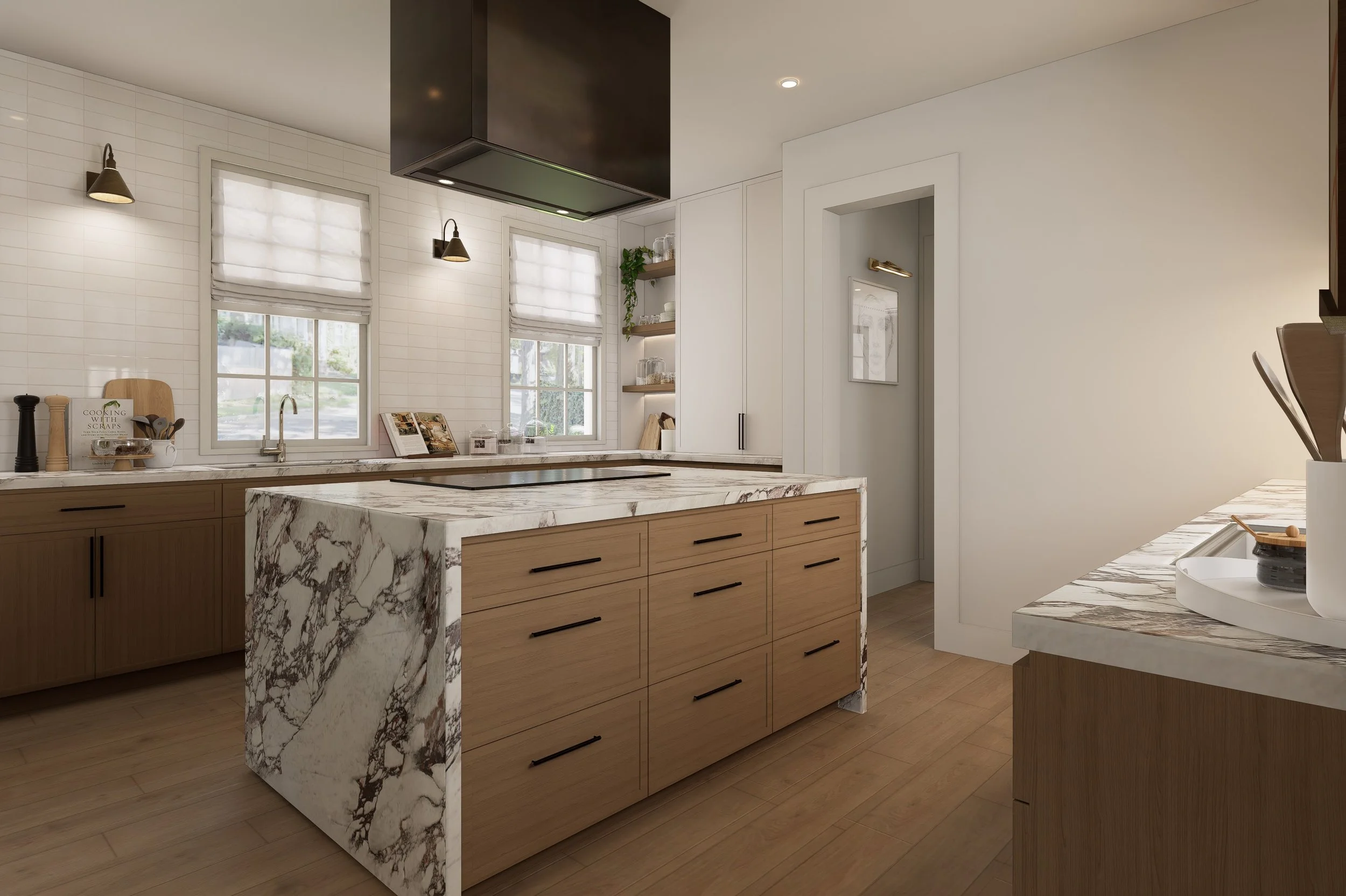
Homeowners sometimes arrive at a rendering presentation having already decided how they feel about it. They have zoomed in on cabinetry, looked up the sofa, and formed an opinion about whether the room is right before our meeting even starts. This is completely understandable as the progress of a future home is incredibly exciting and confirming details start to make it feel real. Unfortunately, it is also very easy misread what a rendering is actually showing you.
A rendering is not a photograph of a finished room but a spatial argument. It is saying: here is how the pieces relate to each other, here is how the proportions feel, and here is the direction we are moving in together. Learning to read it that way, and to trust the things it cannot show, is a valuable skill a homeowner can bring to the design process.
What a Rendering Is Actually Doing
At its most useful, a rendering answers spatial questions that a floor plan cannot. How will a ten foot sofa feel in this room? Does the kitchen island sit correctly in relation to the dining table beyond it? With tall ceilings should there be one row of upper cabinets, or two? These are questions of scale, proportion, and relationship, and a rendering answers them in a way that no amount of description can replicate.
For renovation projects in particular, renderings do work that is specific and essential. Millwork profiles, hardware placement, ceiling details, the relationship between tile pattern and wood threshold: these are the decisions that govern how a space actually reads once it is built, and seeing them in three dimensions before construction begins is an important feature of renderings. It allows conflicts to be caught on screen rather than in the field, which is substantially cost effective and less stressful for all team members.
What a rendering cannot do is show you the finished room. The digital models used to build a rendering are approximations of real objects, not representations of them. The furnishings in a renovation rendering are almost always placeholders chosen for approximate scale and form rather than recommendation. In a high-end project where furniture will be custom or sourced from trade vendors, most pieces are not available in any rendering library so what appears on screen may bear only slightly resemble what will actually be specified. A homeowner who falls in love with the rendering sofa and asks to order it has misread what the rendering is doing, and we will always say so gently before that conversation goes any further.
Trust the Sample, Not the Screen
This is the point most homeowners find counterintuitive and that we make a point of saying clearly at every presentation: the material sample in your hands is the truth. The rendering is the context.
A fabric specified as a deep sage linen will appear in the rendering as whatever the software's closest digital approximation of that fabric happens to be. It may read lighter, flatter, or slightly off in color. The actual sample, the one we have selected from a fabric house and placed in front of you, is what the finished room will contain. That is what to approve.
We hear versions of the same comment on almost every project. "I love this fabric but I'm not sure about the color in the rendering." "The pattern looks different on screen and I don’t like it as much." Our answer is always the same. Look at what is in your hands. Run your fingers across it and hold it next to the other samples on the table. A rendering cannot show you the weight of a Dedar velvet, the particular warmth of an unlacquered brass pull, or the way a zellige tile catches light at different times of the day. Those details are more apparent in person, and will govern how the finished room actually feels.
This is why we always present samples to accompany renderings rather than in place of them. The rendering shows where everything lives. The samples show what everything is. Both are necessary. and neither is sufficient without the other.
What This Means for Renovation Projects
A renovation rendering will always provide more context than in a furnishings project. The cabinet profiles, ceiling height, and relationship between the island and the window are right. But the hardware finish sample approved will read very differently across forty linear feet of digital cabinetry than it does on your swatch. The tile pattern that appears as a field of color on screen will have texture, variation, and grout lines that change the character of the room considerably.
None of this is cause for uncertainty. It is cause for the right kind of attention. In a renovation, trust the spatial decisions you see in the rendering and trust the material decisions you have approved in person. Those two things together are the finished room.
What We Owe You in Return
Trust in a design process is not one-sided. A homeowner who extends genuine trust to our judgment is owed honesty in return.
We always flag when a material or finish will read differently in person than it does on screen. We always distinguish between the furniture shown for scale and the furniture we are actually recommending. We always present samples and renderings together so that the two can be read in relationship rather than in isolation. And we always tell our clients when a decision they are hesitating over will look different in the room than it does on screen, because a homeowner who approves something they are uncertain about is a homeowner who arrives at installation day with unresolved questions rather than genuine anticipation.
When we and our clients leave a presentation with the same picture of where the project is going, the work that follows has a clarity and a momentum that shows in the finished room.
What Installation Day Feels Like
When the rendering process has done its job, installation day becomes a confirmation of the trust you placed in us. You walk into a room having already understood spatially and approved materially, and find that the sum of those decisions is better than any of them were individually. The fabric that read slightly flat on screen has a warmth in person that the rendering could not capture. The hardware that seemed like a small detail turns out to be the detail that pulls the room together. The proportions that looked right on the floor plan feel exactly right in the space.
This is what trust extended during the design process produces. Not a room that surprises you, but a room that exceeds what you imagined, in ways that could have been predicted but is still more than was digitally promised. The rendering showed you the direction and the samples showed you the materials. Your trust in your designer carried you the rest of the way.
Nubuor Designs is an interior design studio based in Beacon Hill, Boston, working with homeowners across the country on projects that deserve to be done right. If you're planning a project and want to understand what working together actually looks like, we'd love to hear more about you and your home. Let's Talk.