Made for Function, Designed For Beauty
Written by Margaret Nubuor
Founder & Interior Designer, Nubuor Designs
In the most extraordinary homes, beauty is present in unexpected places like hinges, registers, drains, and light switch plates. These objects exist to serve a function but have been beautified to show that an appreciation for home can go deeper than in the usual suspects. Where someone cares about the hinge as much as the door, the drain as much as the fixture, and the switch plate as much as the wall it interrupts.
The belief that the ordinary deserves to be beautiful simply because it can be, is what this post is about.
Switch Plates and Outlet Covers
The switch plate is on every wall of every room, at eye level, in plain sight, and in most homes it is white plastic. In a room where every other object has been chosen with genuine conviction, a white plastic switch plate does not live up to the elegance of everything surrounding it. It shows that the attention stopped here, and did not go deeper than absolutely necessary.
A switch plate in unlacquered brass or hand-applied bronze becomes a different object entirely. It has weight, finish, and develops patina alongside the hardware and the fixtures it coordinates with. Specialized switch plates are available in finishes and profiles that rival the finest architectural hardware, and are considerably more than what most electricians specify by default. For a client who understands what they are, they are worth every part of the difference.
Door Hardware
The door handles are one of the most touched objects in a home and one of the most consistently underspecified. They are used every time a room is entered and every time it is left, which over the course of a year amounts to thousands of small interactions, each one an opportunity for the home to communicate something about itself through the quality of what the hand encounters.
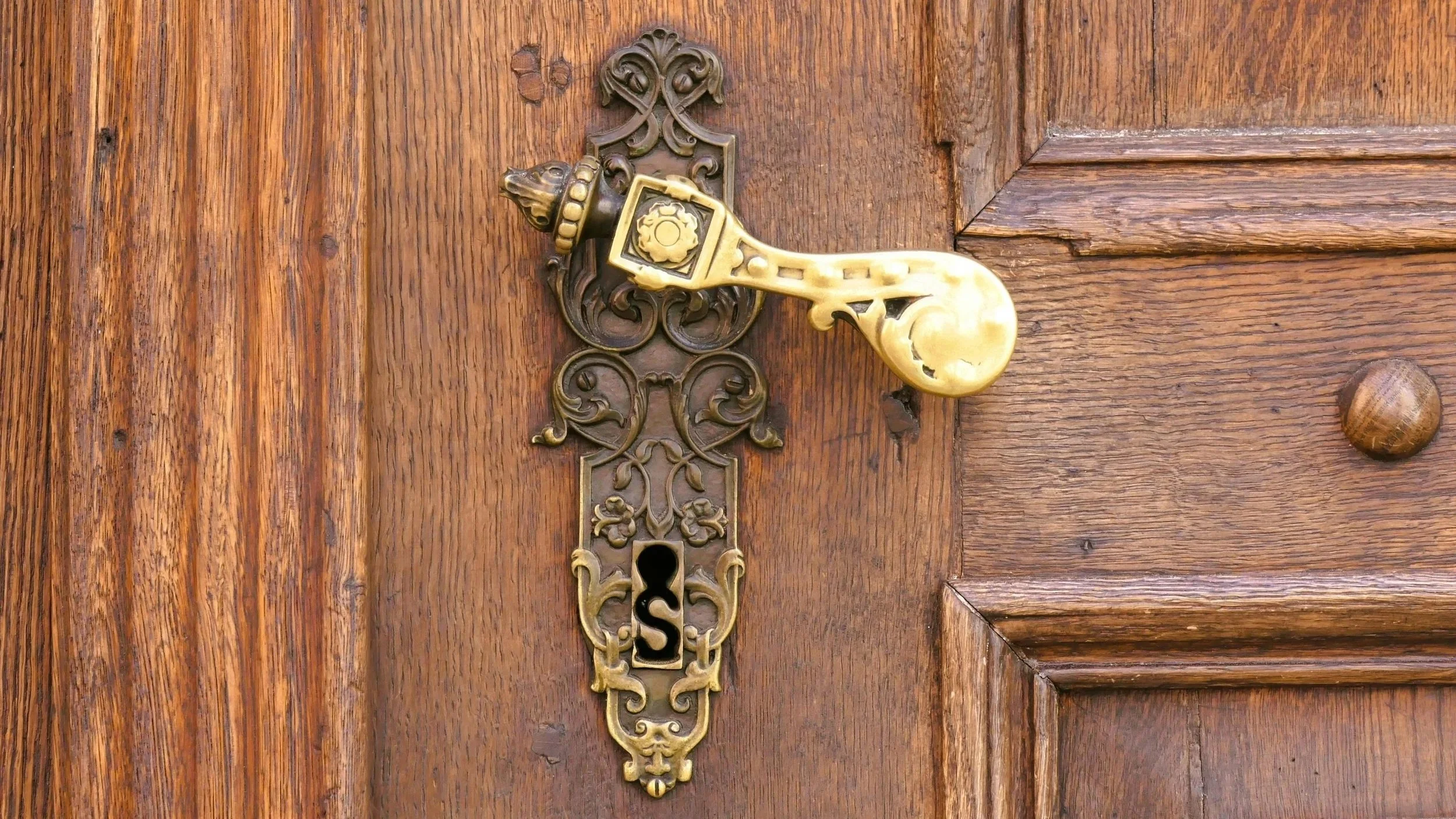
At the level we are describing, door hardware is not a product category but a collection of objects, each one worthy of its own consideration and all of them worthy of each other. The handle, the lockset, the hinge, and the escutcheon should be specified together, in a finish that coordinates with other metals in the space, to create satisfying details in a well-designed interior.
A solid brass or bronze lever handle that operates with a precision is felt rather than heard, showing the quiet certainty of something made properly. These are the details that make entering a room feel like an event rather than a transition. Door hardware at this level is available from manufacturers and artisans that treat each handle as a small sculptural commission, made in solid metal with finishes applied by hand and mechanisms engineered to last.
Hinges are consistently forgotten in this conversation and and can have a massive impact especially on front entry doors. Ball tip hinges in solid brass, heavy duty cast hinges with hand applied patina finishes, decorative strap hinges in blackened iron: the hinge should coordinate with the handle as naturally as the handle coordinates with the hardware elsewhere in the room. It requires only the decision to extend the specification all the way to the barrel of the hinge, which is exactly where most specifications stop.
Cabinet Hardware
A hand-forged pull from a small shop, a knob cast in solid bronze with a finish applied by hand that will develop its own character over years of use. As the jewelry of a space, cabinet hardware does not need to coordinate with every other metal in the room. Cabinet hardware at this level is not a specification but rather a small sculptural object that happens to open a drawer or a cabinet. It can be as frivolous, understated, or utlitatrian as possible - as long as it is both pleasing to see and use.
The difference between hardware made with genuine craft and hardware made to a price point is apparent the moment it is held in hand. Noticing the difference in weight, precision, and depth of the finish is exactly the point.
HVAC Grills and Registers
The HVAC grill is a utilitarian object that generates the most surprise when it is done well, because it is the one that most people have never think to care about at all. Most homes have stamped white metal registers that bear no relationship to anything else in the room. In a home with unlacquered brass hardware and warm stone floors, a brass floor register reads as exactly right.
Custom registers and grills are available in finishes, profiles, and dimensions that integrate into a room's material language rather than interrupting it. A brass floor register set into a herringbone oak floor is not a functional element with a decorative finish but a detail that feels as complete as the furniture above it.
Drain Covers
The drain cover is consistently specified in the wrong finish, usually polished chrome, regardless of what every other metal in the bathroom is. In a bathroom where every fixture is let’s say, polished nickel, a chrome drain is a small but persistent note of dissonance every time the eye reaches the floor.
At the high end, drain covers are available in a multitude of finishes like solid brass, blackened steel, aged bronze, and hand applied patina finishes. Some manufacturers even provide their own drain covers that coordinate with their finish offerings so that the rest of the room coordinates and can patinate at the same rate. Some are designed as objects in their own right, with linear profiles and geometric patterns that make them worth looking at rather than looking past. We specify the drain finish at the beginning of every project and make sure it is on the contractor's radar before rough-in.
Mail Slots and Door Knockers
The front door is the first and last experience of a home, and the hardware on it communicates something about what lies beyond. A mail slot in solid brass with a weighted cover that closes with a satisfying resistance, a door knocker hand-forged in blackened iron with a form that like anything but mass-produced: these are the details that make a front door feel like a genuine arrival.
At the level we are describing, mail slots and door knockers are available from manufacturers and metalworkers who treat each piece as the work of art they are. The patina that develops on a solid brass mail slot over decades of use is one of the most beautiful aging processes available on the exterior of a home. It is also entirely unreplicable from one home to the next.
House Numbers
House numbers are small and semi-permanent decisions on the exterior of a home and are almost universally made with no thought at all. A set of cast brass numerals in a typeface chosen with genuine care, mounted at the right height and the right spacing signal immediately that the home has been thought about from the outside in.
On one project we took this further, designing custom brass house numbers and setting them into a bespoke mosaic tile floor in the foyer, using the address as part of guests’ arrival sequence. The numbers were not on the door but on the floor waiting to elicit an “aha” moment. That kind of detail exists for no reason other than the pleasure of it, which is all the reason it needs.
Metal Inlays
A brass inlay at the threshold between two rooms, a strip of brass separating stone from wood, a compass rose set into a limestone foyer floor, a geometric border that defines the center of a room: these are the details that appear in the great houses and the finest hotels and that communicate, without stating it, that the floor was designed rather than simply covered.
They require planning from the beginning of a project and a skilled installer who has worked with metal inlay before. They also require the willingness to treat the floor or cabinetry as a surface with the same potential as the wall or the ceiling. This is a detail visitors notice immediately and remember long after they have forgotten everything else.
Keyhole Escutcheons and Window Hardware
The keyhole escutcheon is perhaps the most obscure object on this list and one of the most beautiful when it is right. A solid brass escutcheon around a keyhole, a sash lift in hand-cast bronze, a window lock in a finish that coordinates with the hardware elsewhere in the room: these are the details that appear in homes where someone cared about everything, including the things that most designers never think to specify.
Window hardware in particular is an area of significant opportunity. Most windows come with painted aluminum hardware that bears no relationship to the rest of the room. Replacing it with solid brass sash lifts and window locks in a coordinating finish is one of the more quietly transformative detail decisions available in a furnished interior.
On Beauty for Its Own Sake
The objects on this list share one quality above all others. They did not need to be beautiful. None of them required craft, or weight, or finish, or the attention of a maker who cared about the outcome. And yet in the right home, in the hands of someone who believes that beauty is worth pursuing all the way to the edges of a space, they become something else entirely.
They become the evidence of choosing, again and again, to make the ordinary beautiful. That is the home worth inhabiting, and these are some of the objects that make it so.
Nubuor Designs is an interior design studio based in Beacon Hill, Boston, working with homeowners across the country who believe that a well-curated space is one of life's great pleasures. If you're ready to make yours one of them, we'd love to hear more about you and your home. Let's Talk.
Related Posts: