Deco Garden: A Beacon Hill Townhouse, Completely Reimagined
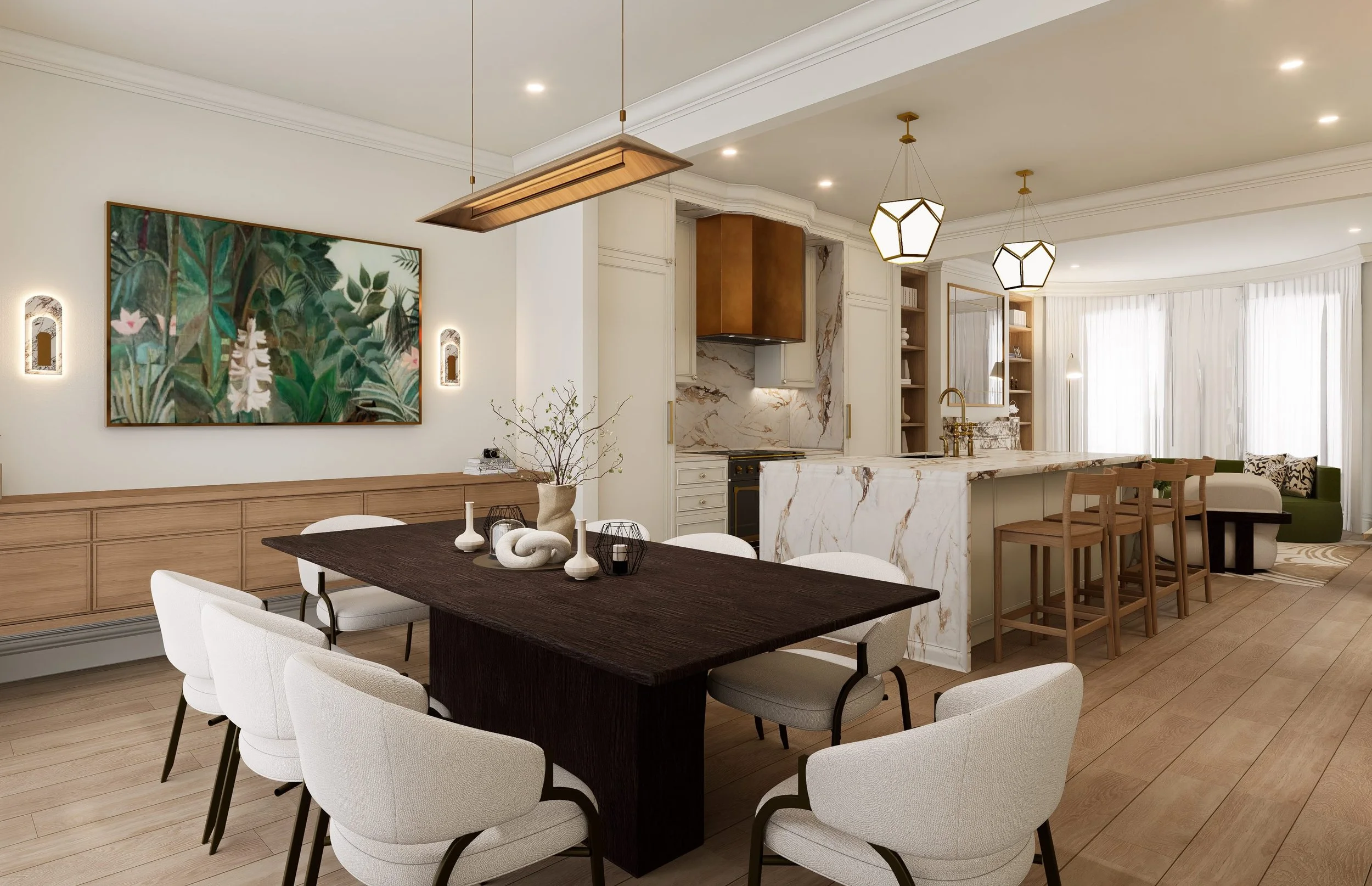
A view from the dining area towards the living room.
Written by Margaret Nubuor
Founder & Interior Designer, Nubuor Designs
Some projects ask you to work within what exists. The Deco Garden project asked something harder: to look at a historic Beacon Hill townhouse with extraordinary bones and a century of piecemeal updates, and decide what it was truly meant to be. All while catering it to a growing family’s need.
That answer required starting over. Not demolishing what made the building special, but stripping away everything that had been layered on top of it and rebuilding the interior as a single, coherent whole. A gut renovation, done with full intention from the floor plan up.
Rethinking the Layout
The first thing I do on any project at this scale is spend time understanding how the people who live there actually move through their days. Where does the morning start? Where does the evening settle? Where do people land when they come through the door? In a Beacon Hill townhouse, those questions have to be answered within a narrow, vertical footprint, which makes every decision about zone and adjacency count.
For this family, the kitchen is the center of that. They cook together, with children and guests pulled in rather than pushed out. So I placed the kitchen literally the center of the main living floor, not tucked to the rear, not hidden behind a wall, but occupying the heart of the plan. A generous pantry sits just beyond it, handling the back-of-house storage and prep work that belongs out of sight without requiring a trek to another floor. The kitchen can be beautiful and functional at once because the pantry carries the burden of the utilitarian.
With the kitchen at the center, the other rooms fell into their natural positions. The dining room is placed toward the garden end of the floor, where it still has a direct relationship with the kitchen but is quieter, and more intimate quality than a dining room adjacent to a living room. The living room anchors the front of the floor, with its tall windows and street-side presence. Each space has its own zone and its own character so they connect without competing.
Arrival gets the same level of thought. An entry vestibule leads into a generous mudroom with ample closet space, dressed in a lush trailing ivy wallpaper that makes the transition from street to home feel deliberate and welcoming rather than abrupt. A cased opening leads into the living area allowing sight lines into comings and goings. The staircase runs the full height of the house at the center of the plan, with the vestibule and mudroom flanking one side and the powder room and pantry flanking the other. Everything that supports daily life is organized around that central spine, leaving the living spaces free of clutter.
The primary suite sits on the floor directly above the main living level, spanning the full width of the house. The bedroom faces front to capture the maximum light through the original deep-set windows. The bathroom sits at the rear, where privacy is complete and the outlook is calm. A primary walk-in closet occupies the middle, acting as a quiet buffer between the two and giving the suite a sequence that feels more like a retreat than a floor plan solution.
The Living Room
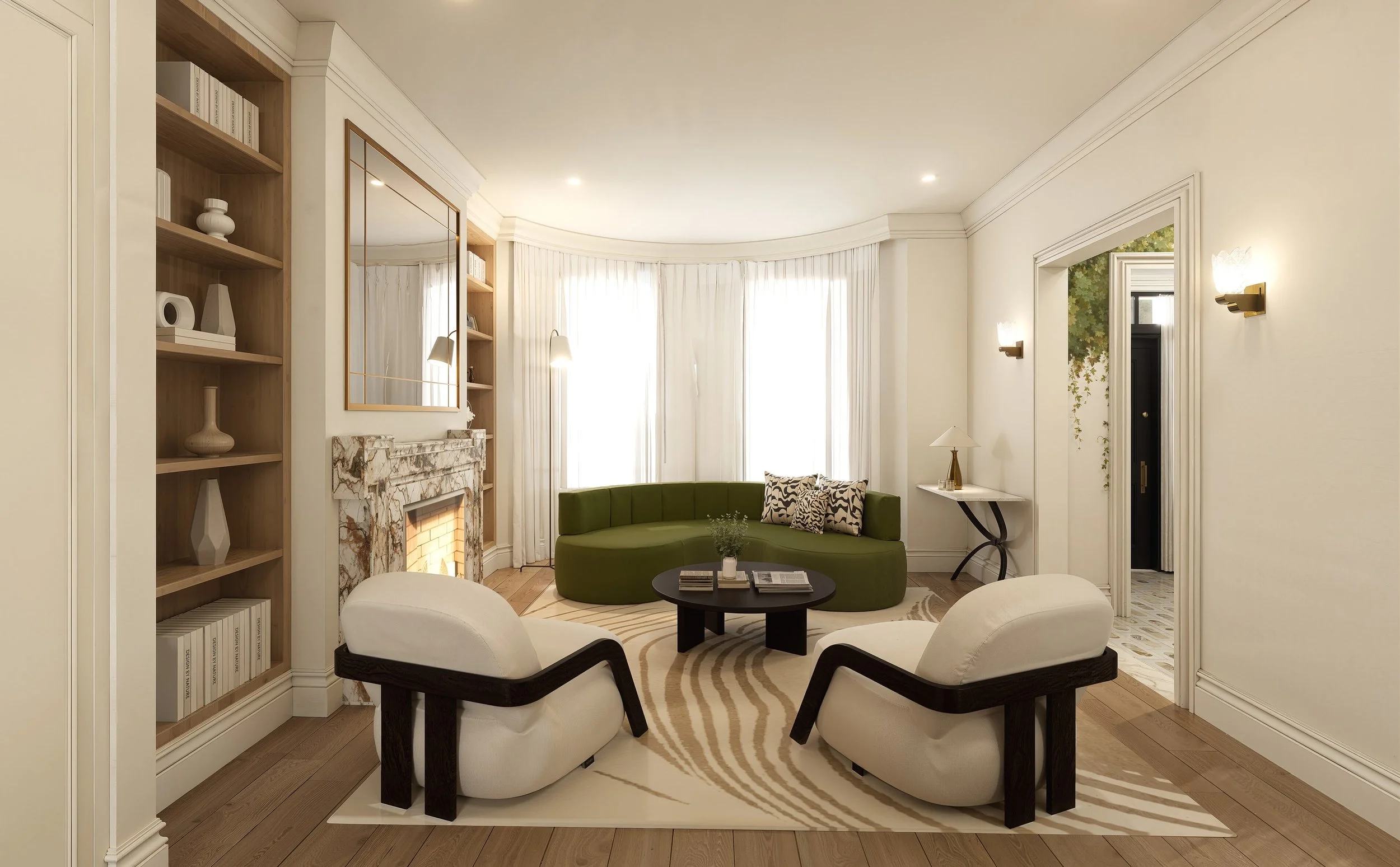
The original marble fireplace surround was preserved without hesitation. Its multicolor veining, cream, sienna, rose, and sage swirling together, reads almost like a painting, and no reproduction could have matched it. Custom oak built-ins flank it on either side, their proportions drawn from the room's existing cornice height. An Art Deco grid mirror in aged brass hangs above the fireplace, a deliberate nod to the project's overarching reference. A deep forest green curved velvet sectional anchors the seating, introducing the gem tone palette at its most saturated, while cream boucle armchairs and an abstract rug in warm taupe keep the room from tipping into heaviness.
The Kitchen
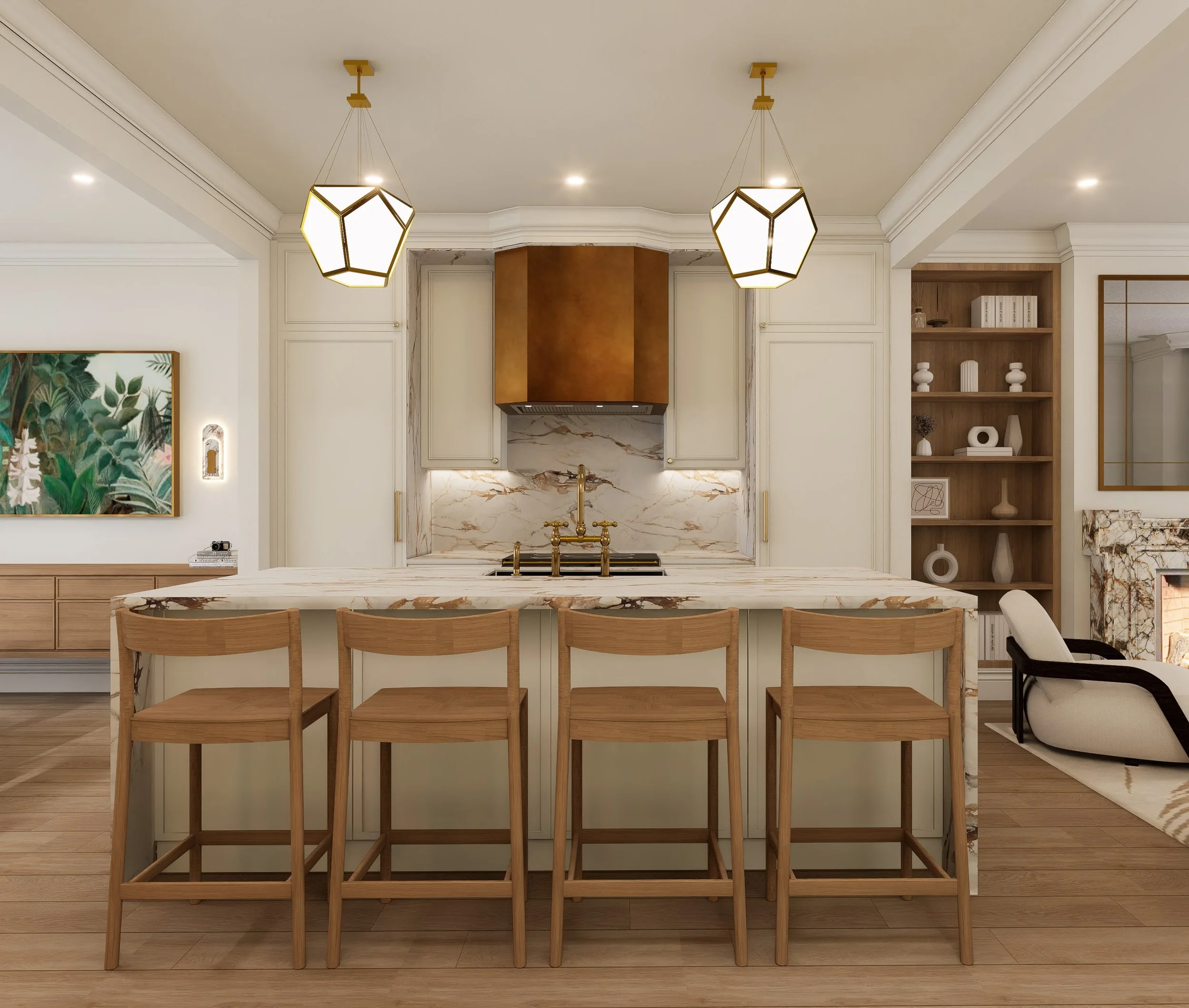
Kitchens in historic Boston townhouses are almost always placed on the rear exterior wall to keep it away from the main path. This one was designed from scratch to be worthy of the home around it, and a focal point simultaneously. A Calacatta Paonazzo marble slab runs from the countertop all the way up the wall behind the range, with an angled brass hood panel set flush within it. The cabinetry is a warm greige inset panel with unlacquered brass hardware throughout. It is a kitchen designed to be cooked in every day and to look beautiful while doing it.
The Dining Room
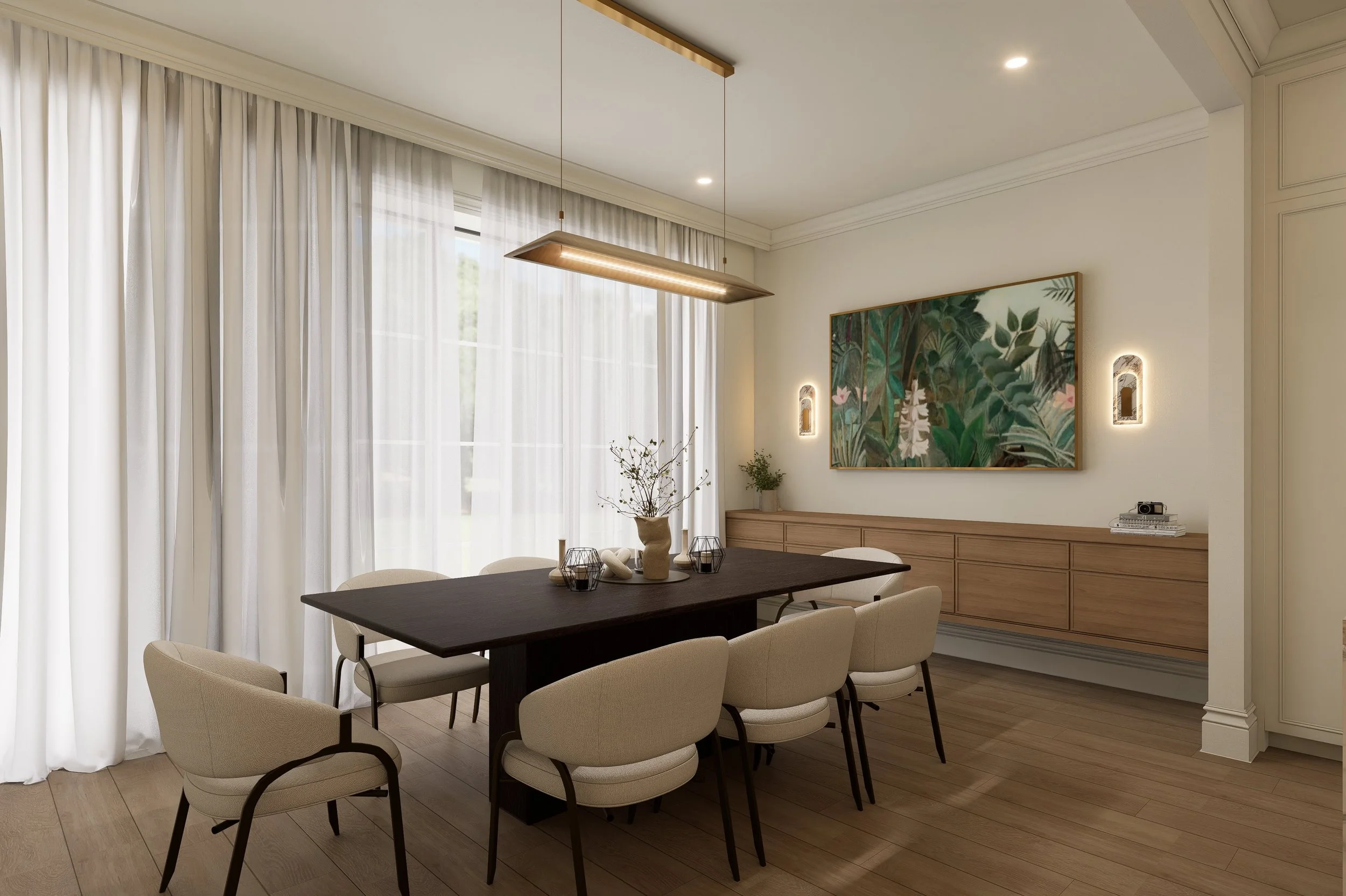
The dining room sits at the garden end of the floor, and the design leans into that fully. Steel-framed glass doors on either side frame direct views to the garden, and a large botanical painting on the opposite wall brings the garden in from the other direction. Dining chairs in ivory boucle with slim arched frames circle a dark architectural table beneath an oak and brass rectangular pendant that provides warm, focused light for evenings. Flanking a floating oak sideboard, a pair of marble arch sconces in rich veined stone add another layer of the project's signature material mix. The centerpiece of the room is a large botanical painting hung on the wall opposite the garden, a lush, jungle-canopied scene that brings the outside in.
The Mudroom
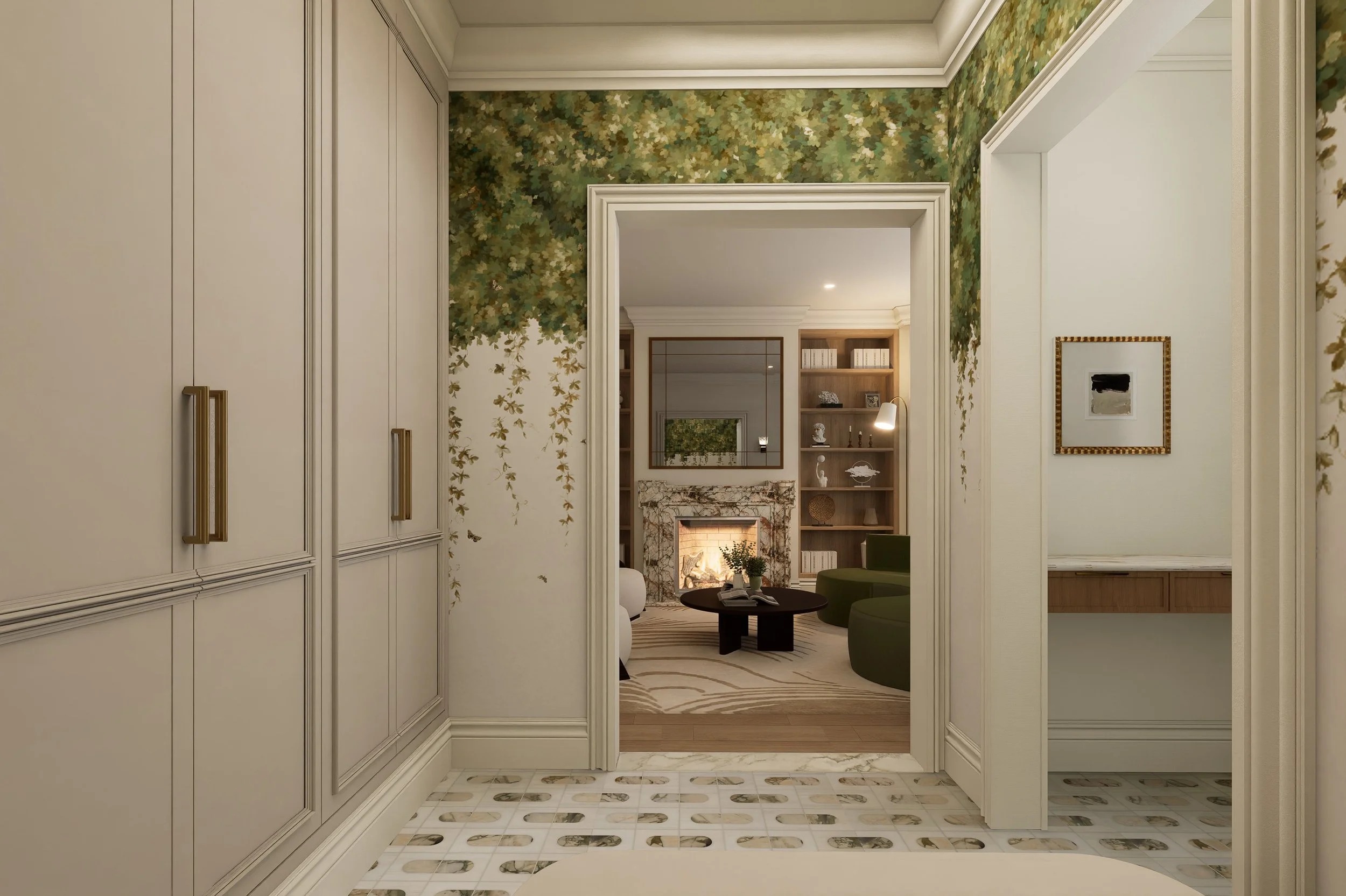
Mudrooms is often treated as a purely functional space, designed for durability and dismissed from the rest of the home's design. Here, it is the first room you fully inhabit when you come through the door, and it gets the same consideration as any other. A trailing ivy wallpaper covers the walls with vines cascading downward with tiny painted butterflies throughout. I incorporated a custom painted cabinetry with ample storage to handle the reality of guests and a busy family's daily arrivals. A separate vestibule space with a floating oak console provides a landing surface for keys, mail, and packages. The floor is tiled in a marble mosaic of softly shaped pill tiles in muted green and white, a quiet nod to the garden underfoot theme that will reappear throughout the home. A geometric brass and lavender glass lantern flush mount overhead gives the room its own moment of personality and introduces the project's subtle use of color in unexpected places.
The Powder Room
If the mudroom is a gentle welcome, the powder room is an immersion. A full-scale jungle mural wraps every wall, dense with dark foliage, tropical canopy, birds, and dappled light. It is the same family of reference as the mudroom wallpaper, the garden, the living world brought inside, but executed at an entirely different color scheme. Where the mudroom is soft and airy, the powder room is atmospheric and enveloping. A floating oak vanity with a single drawer carries an aqua-veined marble top, the stone's teal and green tones pulled directly from the mural behind it. The floor is a geometric marble mosaic in deep green and white, its intricate pattern giving the small space a richness it earns.
The Staircase
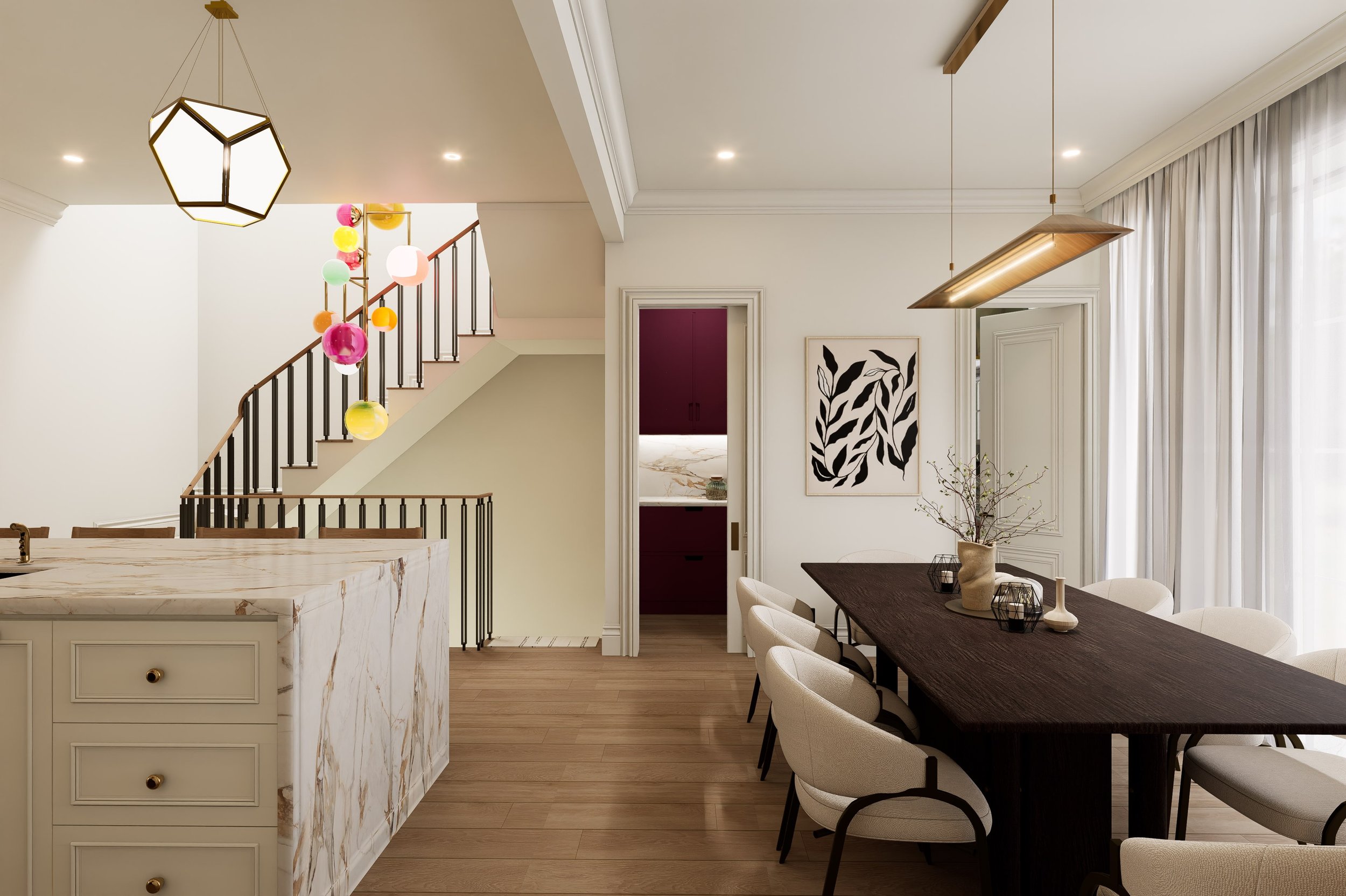
The staircase runs the full height of the house and needed a lighting solution that could travel with it. A cascading chandelier of hand-blown glass globes in amber, pink, rose, clear, and sage descends through the stair void on a brass armature across multiple floors. After the sophistication and restraint of every room around it, this chandelier is pure delight. It introduces color in a way that no other element in the home does, and it makes the vertical journey through the house into an experience rather than a transition. A blackened iron balustrade with a warm wood handrail.
The Primary Bedroom
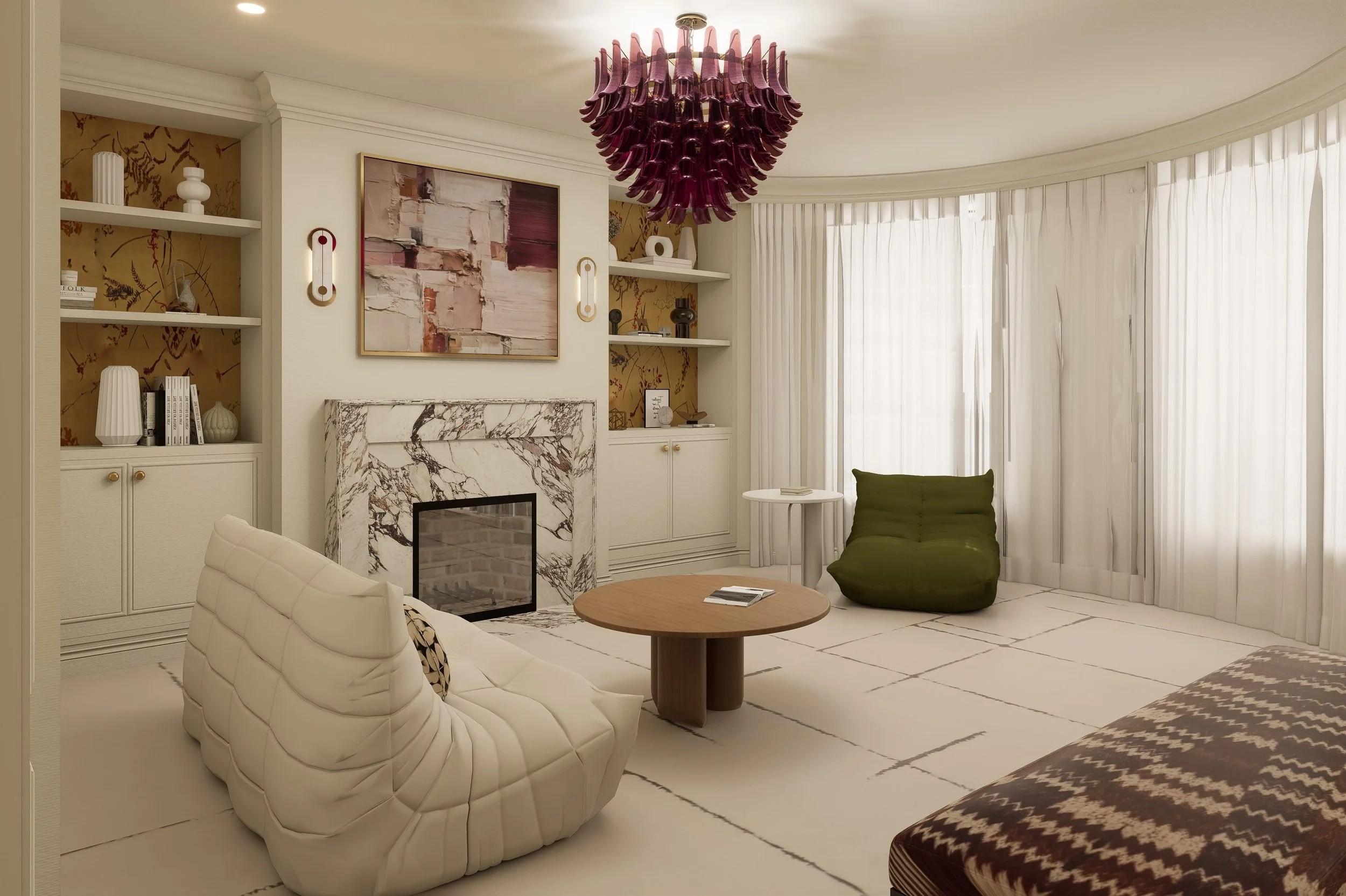
The bedroom leans fully into its position at the front of the house. Full-height sheer linen curtains span the window wall, and the palette is deliberately calm: cream, taupe, warm oak. The statement is saved for the ceiling, where a tiered amethyst Murano glass chandelier introduces the gem tone palette in its most jewel-like form. It is the kind of fixture that changes how a room feels after dark, and it ties together color threads that have been present throughout the house starting in the mudroom.
The Primary Bathroom
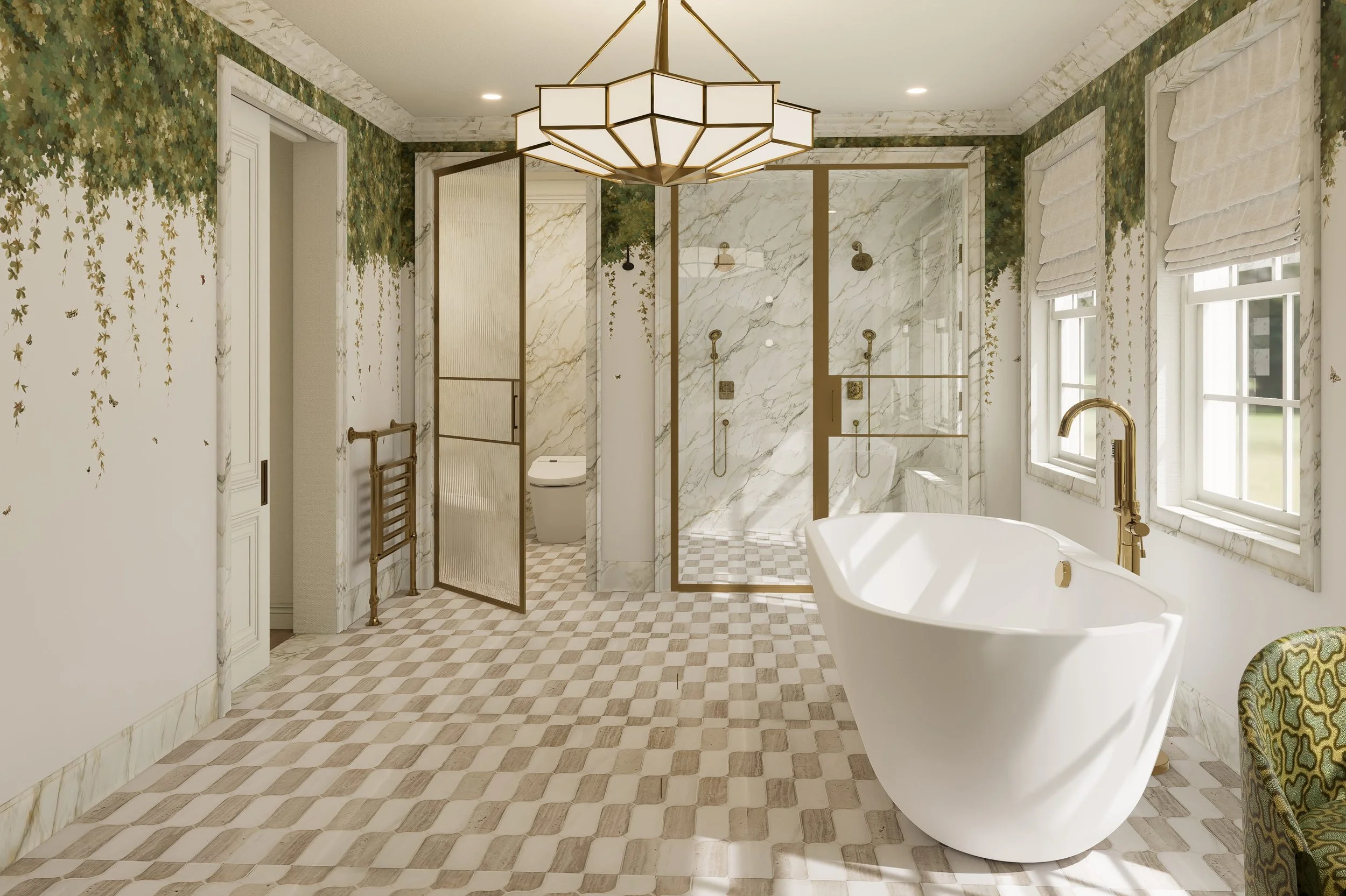
The same trailing ivy wallpaper from the mudroom reappears here at a much larger scale, its vines cascading from a dense ceiling canopy. It is the moment of continuity that ties the house together from its most public threshold to its most private room. A freestanding oval soaking tub sits centered at the window. A large double showerhead wet room in a black steel and glass surround occupies one side. The floor is a two-tone geometric tile that carries the garden floor reference running throughout the project. It is the moment of continuity that ties the house together from its most public threshold to its most private room.
Full-Service Historic Renovation
Boston's historic housing stock makes it one of the most unique spaces in the country. Beacon Hill brownstones, Back Bay rowhouses, Victorian multifamilies in Cambridge and Brookline: these buildings were made to last, and they deserve renovation partners who understand both their history and the needs of their homeowners.
A project like Deco Garden moves through many layers before a single finish is selected. Floor plan revisions, spatial sequencing, material and finish selections, furniture specification, lighting design, and contractor coordination all happen under one roof, with the same goal driving every decision. That continuity matters. It is what keeps a complex renovation coherent from the first sketch to the last detail, and it is what ensures that every choice, from the tile pattern in the bathroom to the placement of a light switch, is precision-targeted to the people who will actually live there. No two clients are the same, and no two projects should be either.
That standard takes longer to achieve but the results speak for themselves for years to come.
Starting a Conversation
If you are considering a comprehensive renovation of a historic Boston property and want a designer who will be present from the initial space plan to styling the last shelf, I would love to hear about your project. My architecture background shapes how I approach projects like this. I work closely with contractors, architects, and preservation consultants when the project calls for it. Let’s Talk.